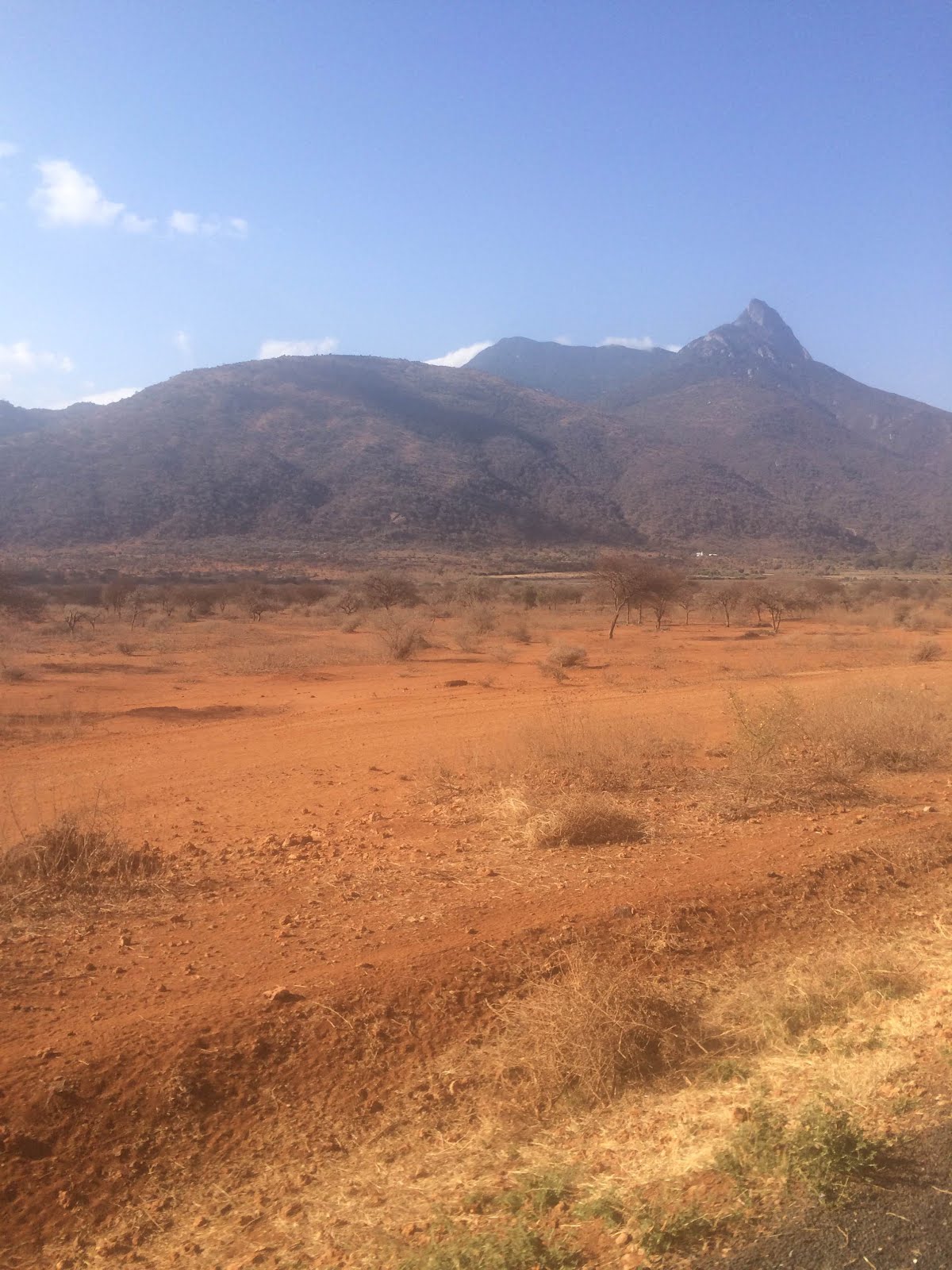
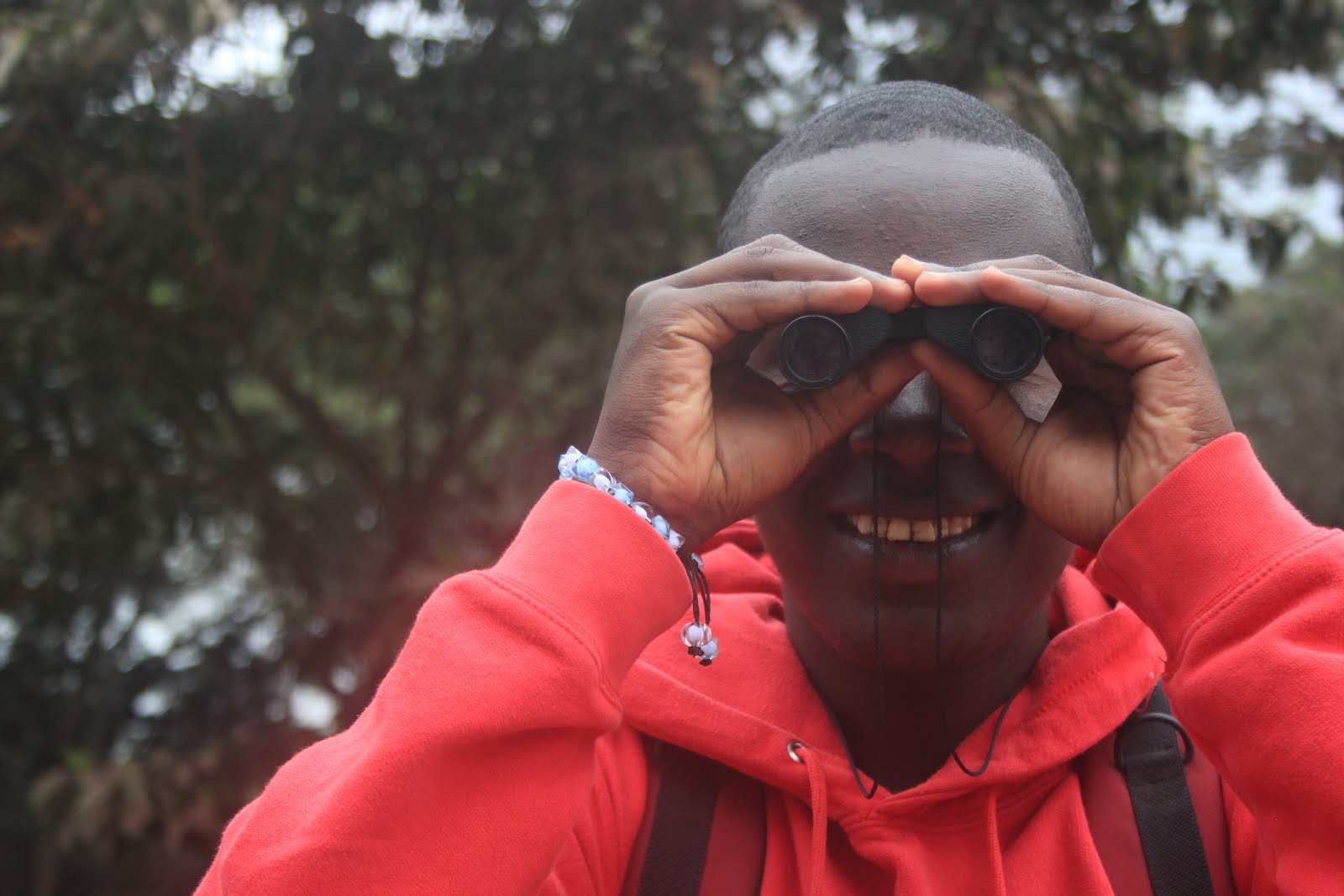
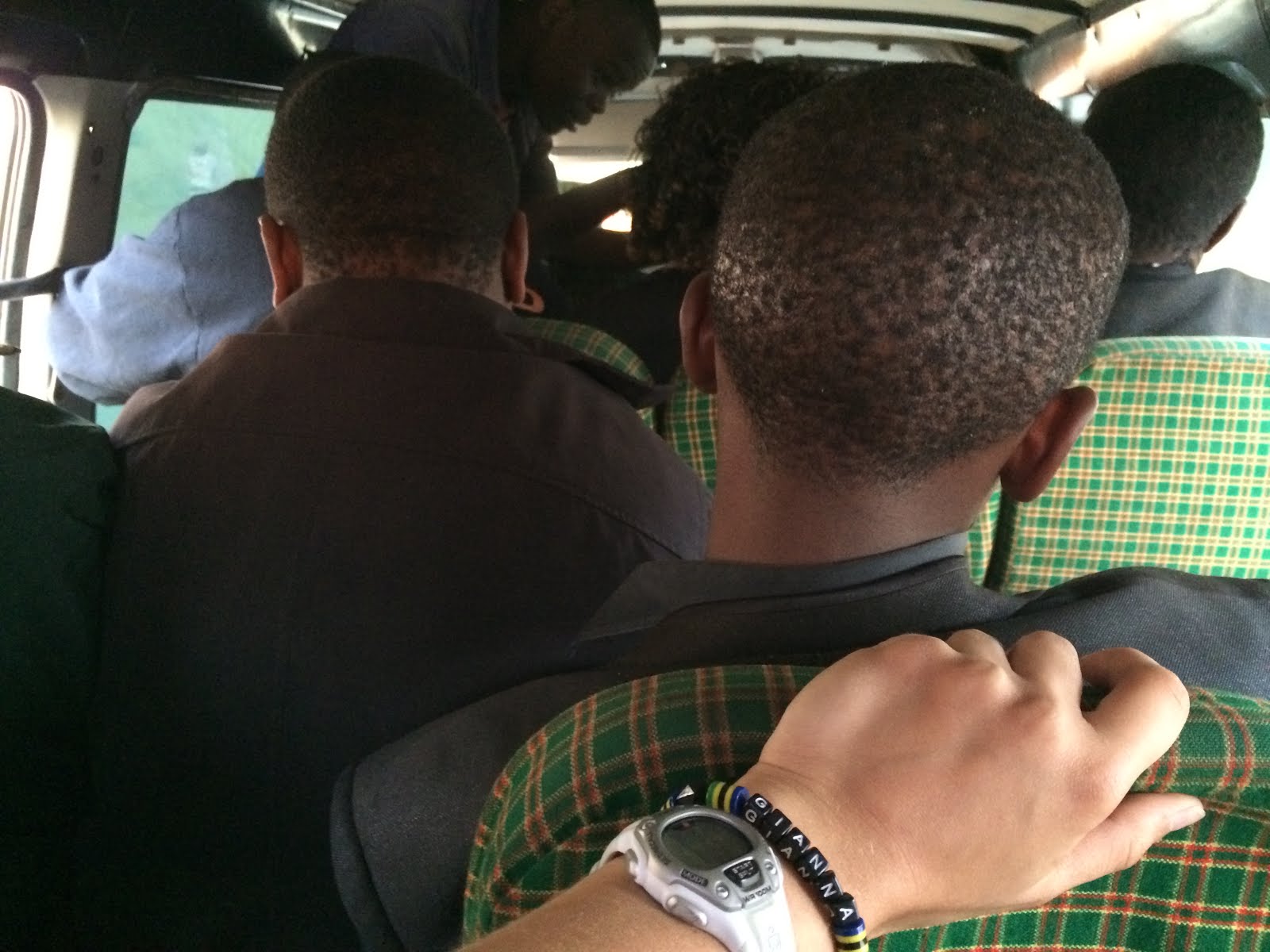
A panda is indeed a black and white animal that is commonly pictured eating bamboo, but that's not relevant here. Rather, "Panda!" means "Climb!" (and a bunch of other things) in Swahili, and that's just what we did this weekend. Over six days, I trekked to Uhuru Peak, Kilimanjaro's highest point at 5,985 m or 19,341 ft, and back down to the park gate along with some great friends and a crew of guides, porters, and a splendid cook.
Here is a subset of the group at the summit.
The short story is that I took a lot of pictures, I ate a lot of good food, and I experienced some degree of altitude sickness. You can probably imagine that I'm pretty tired, so I'll rest now and post more details and pictures next week. In the meantime, as a brief introduction to the Kilimanjaro experience, I'll leave you with some critical key words.
polepole = slowly
maji = water
(those two were the most important)
baridi = cold
kupumua = to breathe
vigumu = difficult
barafu = ice (Barafu Camp was the last place we slept before summit)
(and, of course,) kupanda = to climb
Until next week!
Day-to-day life in Arusha, a young lady versus the Swahili langauge, and adventures all over East Africa
02 October 2016
23 September 2016
Habari
In Swahili, "habari" translates literally to "news," but it's most frequently used as a greeting that awaits a response.
Habari za asubuhi? = News of the morning?
Despite that the literal translation sounds unconventional in English, "Habari za [something]" is used as commonly as "How are you?" and "How is work/school/your day/etc.?"
With that said, here's my habari.
There are so many fun things to do outside of work that I forget to share what's happening at Sikubora. For the past few weeks, Sikubora has been preparing for review by investors. In our startup environment, everyone pitched in to create materials. It's been an interesting opportunity to experience more of the business aspects of Sikubora. I'm learning a lot more than I expected to beyond my major, and maybe one day I'd feel more comfortable trying to start a business.
I just mentioned the myriad fun activities to be done in Tanzania. This weekend we chose Snake Park, which led to many pictures of--you guessed it--snakes, along with some other fun creatures. Please enjoy this montage of Sanae interacting with such creatures.
Here are some other creatures from Snake Park. They are not interacting with Sanae, due to their being either a poisonous snake or a crocodile.
Perhaps my most exciting news lately is that this weekend my friends and I will begin to climb Mt. Kilimanjaro. I'm excited and a little nervous, because it's a long journey with a high elevation and great risk for altitude sickness. The journey will take six to eight days, over which we'll ascend 19,341 ft to the highest point in Africa. Nitakie bahati... wish me luck!
18 September 2016
The Ultimate Journey, Ft. Food
I traveled to Kampala, Uganda over the past weekend, departing Thursday evening and arriving Tuesday morning. By bus. By ~23-hour bus, each way. (It should have been 17 hours, but traffic and border troubles held up the bus traveling both there and back.)
So that was fun! I like to consider the (in reality, exhausting and headache-inducing) bus ride a brief yet exciting safari for which you're mostly forced to stay seated and denied an appropriate amount of bathroom breaks. I'm deeming it a valuable experience because I got to ride through the big cities, small villages, and beautiful countrysides of Tanzania, Kenya, and Uganda. To be fair to the bus, it was pretty snazzy. Check out just how snazzy.
The bus ride gave me a nice picture of life in these East African countries, and I noticed that many characteristics throughout the region are identical. There are pikipikis and daladalas everywhere, there are ditches on the side of the road to collect water and facilitate its flowing, people fry various crops and sell them on the streets, women gracefully balance heavy items upon their heads... the list goes on.
The main differences I saw between Arusha and the places I traveled through were in landscape. Western Kenya and Eastern Uganda are both much greener than Arusha's area, and the dust is a nice, reddish copper tone in contrast to the dull tan I've become accustomed to. My favorite sights from the bus were the Nile River in Uganda and Mt. Longido on the Tanzanian side of the Kenyan border. The Nile is simply huge and beautiful, and Longido (8652 ft tall) is a gem that I didn't realize is relatively in my backyard.
Another huge difference is the language scene. In Tanzania, Swahili is primary and English quite secondary. In Kenya, Swahili is worse and slang-heavy, and English is used frequently. Ugandan English is quite impeccable in many cases, but almost no one speaks Swahili--Luganda is the Ugandan preference and it's not really similar to Swahili. As I traveled from Tanzania through Kenya to Uganda, Swahili got worse and worse but English got better and better.
So, similarities and differences aside, traveling to Kampala offered a unique experience quite different from my day-to-day life in Arusha. You're probably wondering why I wandered all the way over to Kampala in the first place. I went in order to play in the 9th Annual Seven Hills Ultimate Frisbee Tournament. My friend in Arusha connected me with her team coming all the way from Canada, and we all met in Uganda to play Saturday and Sunday with 10 other teams whose players came mostly from Uganda, Kenya, Tanzania, and Rwanda.
In order to avoid rambling too much, I've listed a few highlights of the weekend below.
- I made new friends and connections in the East African ultimate community.
- Our team won the spirit award!
- I got a really cool, fluorescent red-orange Uganda disc.
- Big birds
- Food
If you read my bird-watching post, then you know how much I love birds. Imagine me seeing one more than half my height with a really great mohawk--I was immeasurably happy. Someone told me that these are the Ugandan equivalent of the seagull, in that they reside by water, are ubiquitous, and get in the way. As it turns out, this bird is called the grey crowned crane, it's the national bird, and it's even in the center of the Ugandan flag.
Check out this superb picture my friend captured of a grey crowned crane checking out some ultimate frisbee on the side of our field.
Anyway, it's easy for me to get distracted by birds, and I should be talking about what I got from playing in the tournament. It was different from playing ultimate in Arusha (which I'll post about at some point). Uganda can probably be considered the hub of ultimate in East Africa, and it was refreshing to watch the clean plays run by those teams. There's a lot of natural talent and athleticism around this awesome sport in East Africa, clearly shown over the weekend. All in all, my favorite part of the tournament was simply the opportunity to witness the development of ultimate frisbee in this part of the world. It's truly an infectious sport, and most people I know who try it enjoy it and play again. I had a lot of fun yet also enhanced my understanding of the global framework of my favorite sport.
Finally, I want to elaborate on the "food" highlight I listed. Uganda offered some delicious local foods that I haven't encountered in Arusha. This is rollex, a popular breakfast option that is essentially a thin omelette wrapped in chapati (where chapati, my favorite snack in Arusha, is an unleavened circle of deliciously oiled and cooked dough--similar to a tortilla but far superior).
Below is my plate from the tournament lunch, packed with traditional Ugandan food. That yellow mushy stuff is called matooke, and it's personally my least favorite. It's cooked and mushed banana, but not the fruity kind of banana that I'm used to at home in America. It's a variety commonly referred to as "cooking banana" and it's everywhere in East Africa, but it's more starchy and less sugary than the good kind of banana. Forget the matooke. That yellow ball to the upper left of it was some sort of potato situation I think, and to the right of it you can see chapati once again. Then there's a delicious, purple-brown colored sauce hiding at the back of the plate. It's called g-nut sauce and I could eat it by itself for days on end.
I can't fully convey how ecstatic I was to encounter the scrumptious sambusa in the picture below. Sambusa is basically the same thing as Indian samosa for those who are familiar. Take a delectable meat or vegetable filling and triangularly enclose it with a crispy and delicious shell. Sambusa are quite popular in Arusha, but they're half the size of the one taking up my whole hand (I don't have small hands) that I purchased while waiting for my return bus in Kampala. This sambusa was a great find for a couple of reasons. First, it was hot and I was hungry when I saw the man and his life-giving sambusa bucket. Second, it cost me 500 Ugandan Shillings. In Arusha, sambusa cost 500 Tanzanian Shillings each, but 1 TZS equals 1.55 UGX, so a giant sambusa in Uganda costs less than a much smaller sized one does in Arusha. In USD, my gargantuan sambusa costed $0.15. Mind-blowing. Life is so good.
I have no problem ending this post on a food discussion. The goal now is to learn how to prepare East African foods and bring a delicious revolution to Boston when I return.
So that was fun! I like to consider the (in reality, exhausting and headache-inducing) bus ride a brief yet exciting safari for which you're mostly forced to stay seated and denied an appropriate amount of bathroom breaks. I'm deeming it a valuable experience because I got to ride through the big cities, small villages, and beautiful countrysides of Tanzania, Kenya, and Uganda. To be fair to the bus, it was pretty snazzy. Check out just how snazzy.
The bus ride gave me a nice picture of life in these East African countries, and I noticed that many characteristics throughout the region are identical. There are pikipikis and daladalas everywhere, there are ditches on the side of the road to collect water and facilitate its flowing, people fry various crops and sell them on the streets, women gracefully balance heavy items upon their heads... the list goes on.
The main differences I saw between Arusha and the places I traveled through were in landscape. Western Kenya and Eastern Uganda are both much greener than Arusha's area, and the dust is a nice, reddish copper tone in contrast to the dull tan I've become accustomed to. My favorite sights from the bus were the Nile River in Uganda and Mt. Longido on the Tanzanian side of the Kenyan border. The Nile is simply huge and beautiful, and Longido (8652 ft tall) is a gem that I didn't realize is relatively in my backyard.
Another huge difference is the language scene. In Tanzania, Swahili is primary and English quite secondary. In Kenya, Swahili is worse and slang-heavy, and English is used frequently. Ugandan English is quite impeccable in many cases, but almost no one speaks Swahili--Luganda is the Ugandan preference and it's not really similar to Swahili. As I traveled from Tanzania through Kenya to Uganda, Swahili got worse and worse but English got better and better.
So, similarities and differences aside, traveling to Kampala offered a unique experience quite different from my day-to-day life in Arusha. You're probably wondering why I wandered all the way over to Kampala in the first place. I went in order to play in the 9th Annual Seven Hills Ultimate Frisbee Tournament. My friend in Arusha connected me with her team coming all the way from Canada, and we all met in Uganda to play Saturday and Sunday with 10 other teams whose players came mostly from Uganda, Kenya, Tanzania, and Rwanda.
In order to avoid rambling too much, I've listed a few highlights of the weekend below.
- I made new friends and connections in the East African ultimate community.
- Our team won the spirit award!
- I got a really cool, fluorescent red-orange Uganda disc.
- Big birds
- Food
If you read my bird-watching post, then you know how much I love birds. Imagine me seeing one more than half my height with a really great mohawk--I was immeasurably happy. Someone told me that these are the Ugandan equivalent of the seagull, in that they reside by water, are ubiquitous, and get in the way. As it turns out, this bird is called the grey crowned crane, it's the national bird, and it's even in the center of the Ugandan flag.
Check out this superb picture my friend captured of a grey crowned crane checking out some ultimate frisbee on the side of our field.
(Image courtesy of the wonderful Naomi Garneau)
Anyway, it's easy for me to get distracted by birds, and I should be talking about what I got from playing in the tournament. It was different from playing ultimate in Arusha (which I'll post about at some point). Uganda can probably be considered the hub of ultimate in East Africa, and it was refreshing to watch the clean plays run by those teams. There's a lot of natural talent and athleticism around this awesome sport in East Africa, clearly shown over the weekend. All in all, my favorite part of the tournament was simply the opportunity to witness the development of ultimate frisbee in this part of the world. It's truly an infectious sport, and most people I know who try it enjoy it and play again. I had a lot of fun yet also enhanced my understanding of the global framework of my favorite sport.
Finally, I want to elaborate on the "food" highlight I listed. Uganda offered some delicious local foods that I haven't encountered in Arusha. This is rollex, a popular breakfast option that is essentially a thin omelette wrapped in chapati (where chapati, my favorite snack in Arusha, is an unleavened circle of deliciously oiled and cooked dough--similar to a tortilla but far superior).
I can't fully convey how ecstatic I was to encounter the scrumptious sambusa in the picture below. Sambusa is basically the same thing as Indian samosa for those who are familiar. Take a delectable meat or vegetable filling and triangularly enclose it with a crispy and delicious shell. Sambusa are quite popular in Arusha, but they're half the size of the one taking up my whole hand (I don't have small hands) that I purchased while waiting for my return bus in Kampala. This sambusa was a great find for a couple of reasons. First, it was hot and I was hungry when I saw the man and his life-giving sambusa bucket. Second, it cost me 500 Ugandan Shillings. In Arusha, sambusa cost 500 Tanzanian Shillings each, but 1 TZS equals 1.55 UGX, so a giant sambusa in Uganda costs less than a much smaller sized one does in Arusha. In USD, my gargantuan sambusa costed $0.15. Mind-blowing. Life is so good.
I have no problem ending this post on a food discussion. The goal now is to learn how to prepare East African foods and bring a delicious revolution to Boston when I return.
07 September 2016
Ziwa Duluti
One of my favorite parts about living in Arusha is the city's proximity to natural beauty. Once you get tired of cars and people and dust everywhere, you can escape relatively easily to rivers, lakes, hills, waterfalls, and many national parks. This weekend I did just that and went with some friends to Ziwa Duluti, or Lake Duluti. (Fun fact: the plural of lake and the word for milk are the same--maziwa.) We took the daladala and walked about a mile, then arrived at a tranquil lodge by the lake. There, we ate kuku (chicken) and chipsi mayai (basically an omelette situation with french fries inside). Having such scrumptious food and lakeside seats is the stuff of dreams after a long week at work; it was nice to relax in a peaceful place.
Sitting and simply being in nature is great as it is, but my favorite part of our day at Duluti was canoeing. The four of us split into two canoes and set off to explore the environment. There we are below. In the foreground, you can see my lovely selfie smile and my paddle minion, and the background you can see my much lovelier roommate and a friend.
From the middle of the lake, we saw a different view of the majestic Mt. Meru than we usually do from town. You can see that my friend is also majestic.
On one side of Duluti, we found a lovely colony of large birds. (I didn't have Birds of East Africa on my person, so I don't know the species.)
I think my favorite sight seen from the canoe was a few monkeys hanging out in a tree. I was ridiculously excited because it was the first time I'd ever seen monkeys not in a zoo. You can check out the video below and share in my excitement! Maybe. It's hard to see the monkeys, but if you look for moving branches you can find them.
I left Duluti feeling refreshed and ready for the coming week, and with a few thoughts to share in my blog post. Spoiler alert: this weekend I head to Uganda for an ultimate tournament, so you can reasonably expect to read about that next. Nawatakieni wiki njema, na baadaye!
Sitting and simply being in nature is great as it is, but my favorite part of our day at Duluti was canoeing. The four of us split into two canoes and set off to explore the environment. There we are below. In the foreground, you can see my lovely selfie smile and my paddle minion, and the background you can see my much lovelier roommate and a friend.
From the middle of the lake, we saw a different view of the majestic Mt. Meru than we usually do from town. You can see that my friend is also majestic.
On one side of Duluti, we found a lovely colony of large birds. (I didn't have Birds of East Africa on my person, so I don't know the species.)
I think my favorite sight seen from the canoe was a few monkeys hanging out in a tree. I was ridiculously excited because it was the first time I'd ever seen monkeys not in a zoo. You can check out the video below and share in my excitement! Maybe. It's hard to see the monkeys, but if you look for moving branches you can find them.
02 September 2016
Airplane Watching
First and foremost, someone reading this post must understand that the Swahili word for bird and the Swahili word for airplane are actually the same word--"ndege." For all I know, "ndege" could refer to anything flying in the sky. I wonder what confusion this leads to in conversation. If someone says, "Angalia! Ndege!" does it mean, "Look! A bird!" or "Look! An airplane!?" I think that it must waste conversation time and that Swahili should find an additional word to use, mostly because birds are awesome and they deserve to be distinguished from the very different, lifeless, metal people-carriers in the clouds.
Anyone who meets me knows within a few days that I'm obsessed with birds, and now you do too. They're my favorite animal, and I must have been one in a past life. As a result, not long after moving to Tanzania, I started receiving invitations to go bird-watching. This weekend, I was finally able to join a group of PROTS students in journeying to Maji ya Chai to watch birds--kuangalia ndege.
PROTS stands for the Professional Tourguide School. Since Tanzania hosts a robust tourism industry, many students after secondary school choose to study all things related to the profession, including business aspects as well as geography and ecology. My friends who invited me were going with a group of their classmates to put their bird-watching skills into practice.
We traveled all the way to Maji ya Chai, a good hour's ride outside of town, on the daladala. The name Maji ya Chai means "Tea Water," and the area is named this way because its river is home to water with a dark brown color like tea. Once I got there, I knew I'd have a great day stalking birds. After pouring out of the daladala, the students started pulling out their binoculars and Birds of East Africa manuals, my new favorite book without a doubt. Being surrounded by at least eight copies of it was amazing. At any point during the trip, I could look at any bird of East Africa I pleased and learn about its appearance, habitat, mating call, and life cycle.
In Maji ya Chai, I saw the following birds: emerald-spotted wood-dove, ring-necked dove, red-eyed dove, three-banded plover, brown-breasted barbet, cardinal woodpecker, African black-headed oriole, white-headed buffalo-weaver, taveta golden weaver, Peter's twinspot, grey-headed kingfisher, malachite kingfisher, bronze mannikin, white-browed coucal, common bulbul, sacred ibis, hadada ibis, hamerkop, tropical boubou, long-tailed fiscal, common fiscal, yellow white-eye, African hoop, and many, many more. (Admittedly, I sat with my tour-guide friend while writing this post in order to remember all them. Now you can procure a copy of Birds of East Africa and check them out for yourself! Then mail your copy to my house please.)
Of all the birds I've seen so far in Tanzania, my favorite is the superb starling. Its wings are a bright, shiny blue color to ward off predators. I think I'm drawn to small blue shiny things. I looked back at some pictures I had from traveling to Albania this summer and found the one below, with a shiny blue dragonfly. I had an earlier picture on my phone of the superb starling, so I've added that since the ones I saw this weekend were too far away to photograph effectively. Here's a side-by-side comparison of blue shiny things.
Never have I been in the same place as so many other bird lovers at once. It was great. I'm glad I got to enjoy a nice weekend activity so different from work. In contrast, I'm working this Saturday morning. It's my turn in a rotation of our employees to staff the office for half the day, in case any customers come in with needs for their solar home systems or any new faces appear with an interest in our services. After work, I might be able to join up with bird-watching friends for another trip. Fingers crossed!
25 August 2016
Kwa Daladala
Did you just say "dollar dollar" with a horrendous Boston accent? Nope, I'm talking about the daladala, which is a rather fascinating method of public transportation in Arusha. Standing above one of the city's bus hangouts, you can see a swarm of them.
Below is Kilambero, a large daladala station in the center of town.
Every morning, my roommate and I take a daladala from our home to Kilambero. (We're fortunate that in the mornings, daladalas pass right outside our apartment.) From Kilambero, we board another daladala to Kisongo, where Sikubora is located. Crudely described, a daladala is a small, ex-hippie-looking van-bus with its original acceptable number of seats vetted so that an inappropriate number of seats can be crammed in.
Just as it sounds, inside a daladala it can get pretty crowded. The van has 15 seats in its main compartment, as well as two additional seats to the left of the driver. (We drive on the other side of the road here!) Sometimes there's an additional bench just behind the driver and front seats where passengers can sit facing backwards, interlacing their knees with their counterparts on the opposite bench. Contrary to its assumed capacity, most daladalas carry more than 17 passengers at any given time. Additional people cram into the van and assume a standing position in whatever floor space has remained available after an acceptable load has already boarded. This population doesn't include the konda, who announces the names of the van's stops, pulls in new customers, and handles the collection of money. The term "konda" is borrowed and adapted from the English word "conductor." Given that there's little additional space, the konda usually hangs halfway out the window. This position is also advantageous for shouting the daladala's destination to potential customers. The picture below shows the interior of daladala at a much lower than average capacity.
In this next picture, I had bumped into a coworker on the way to work. Because the previous daladala to Kisongo had just departed, the coveted front seats next to the driver were available. We hopped in and enjoyed a glorious ride to work with the least amount of cramming you can find in the daladala. These days are to be treasured.
One of my favorite features of the daladalas is their wild appearance. They could be plain white vans with stripes color coded to indicate destination (which, these days, are not that accurate), but instead most have an assortment of stickers slapped onto their exteriors. One time I saw one that read "Holly Bible" (not my spelling error, but rather taken verbatim from the sticker). In fact, many of these decals are religiously themed. Other common finds are a bible verse number, the face of Jesus in sticker form, and, a crowd favorite, "Work Hard Pray Hard."
My other favorite part about the entire daladala experience is the lack of information available. There's no Google Maps transit help or any maps printed locally and placed upon the routes. You have to know your destination and whatever connection routes are necessary to get there. It's like a fun puzzle, if you look at the situation optimistically. If you don't know where you're going, kondas can be aggressive at Kilambero and other bus hubs in pulling you toward their daladalas. This frequently happens to foreigners, as it is assumed that they don't know where the heck they're going. The kind way to indicate that you're all set is to say "asante," which simply means "thank you." If you are polite and assertive, you can have a fruitful daladala experience.
Another important vehicle worth mentioning is the pikipiki, or bodaboda. (I promise that not all vehicles have Swahili names in this double-word format.) Pikipikis are motorcycles, and the local term bodaboda (also motorcycle) comes from the idea that a motorbike can take you from one edge of a region to the other, or from "border to border." In this picture, taken outside Sikubora's office door, you can actually spot both a daladala and a pikipiki at once (and Mount Meru). I hope this helps to illustrate how ubiquitous both of these vehicles are in Arusha.
I've been told--and I believe it now that I have witnessed it myself--that taking a pikipiki in the center of town is incredibly dangerous. The drivers are quite careless, driving recklessly and swerving around the numerous obstacles presented. In contrast, outside of town the pikipiki can be a relatively safe and inexpensive method of transportation. Here you can see our crew traveling outside town near Usa (not U.S.A, but rather the name of a river), using pikipikis to get to a village far from the main road.
It's true that pikipikis and daladalas are driven crazily in town. However, it is my firm belief that you are safer inside a daladala than inside a car next to one. The drivers are usually quite experienced, so although it may feel like there are some close calls, it would probably be less likely to get into an accident if you were a daladala passenger than if you were a car driver who suddenly needed to react quickly to avoid a daladala. Fear not, the journey to work seems pretty safe and I'm enjoying paying about 20 cents per daladala ride as opposed to Boston's transit fares. I'll take advantage of it while it lasts.
Sasa naenda kulala. Usiku mwema na lala salama! // Now I am going to sleep. Goodnight and sleep well!
16 August 2016
A Penny for Your Swahili Thoughts
If you've ever seen The Lion King, you know about a young cub named Simba and his adventures. You probably also know that "hakuna matata" means "no worries." But did you know that this is Swahili!? Okay, maybe you did, but I, on the other hand, am embarrassed to admit that I had no clue that Swahili words were hiding in The Lion King until I came to Tanzania. Here are some others.
- simba = lion
- rafiki = friend
- pumbaa = stupid or foolish
There's much more to Swahili than Disney's animal names, of course. One word I hear often is "karibu." Karibu means everything. It doesn't actually translate to the word "everything," but it does translate to a lot of other words.
- Karibu = welcome (to a place)
- Karibu = you're welcome (after thank you, or before thank you for that matter)
- Karibu = near or nearby
- Karibu sana = you're very welcome
- Karibu tena = come again
- Hivi karibuni = soon
Another word used quite frequently is "pole." It's sort of like "sorry," but it's not like "sorry" because a better word for "sorry" or "excuse me" is "samahani." I like to think of "pole" as Swahili's "awww." If you trip and fall in the street, you'll hear "pole." If you express that you're mildly tired, you'll get a "pole." Almost any time someone wants to express some sympathy, the word "pole" is the go-to.
There are also some interesting verbs.
- kujenga = to build (Have you ever played jenga?!)
- kusaidia = to help
- kujisaidia = to poop, literally "to help oneself"
- kuoa = to marry (if you're a man, because in this culture, the man marries the woman)
- kuolewa = to be married (this one can safely be applied to women)
- kumiss ... this one isn't actually Swahili. My friends will text "nakumiss" or "nakumic," which are their English/Swahili compromises in saying "I miss you."
There's a lot of familiar English hiding in Swahili. In fact, a large group of nouns are borrowed from a collection of languages, including English, Arabic, German, and Portuguese. The word "Swahili" itself was a word used by early Arabs visiting the coast, and it means, anticlimactically, "coast." Portuguese controlled coastal areas of East Africa from 1500 to 1700, Germany governed parts of Tanzania from the late 1800s, and during the 1900s, British mandate came into play.
- shule = school (German)
- meza = table (Portuguese)
- sita, saba, tisa = six, seven, nine (Arabic)
- basi = bus
- betri = battery
- boksi = box
- dansi = dance
- kompyuta = computer
- pensili = pencil
- redio = radio
- sola = solar ... I ought to know this one by now.
The list goes on. All of these nouns belong to a special noun class for borrowed nouns. There are seven noun classes, by the way, each one subject to its own set of prefixes, infixes, and suffixes for proper grammatical agreements. Who thought it would be a good idea to have seven noun classes? Here's the life-saving noun class agreement chart at the back of my kitabu cha Kiswahili (Swahili book... book is ki/vi class if you're curious) for reference.
The last Swahili penny thought I'll share concerns the term "mzungu." At first I was mildly offended by this term. Well, that's not true. Before that, during the real "at first," I had no idea what it meant but I heard people saying it on the streets in my general direction. Then I found out that it means "white person," at which point I became mildly offended. After consulting some wenyeji (natives), I learned that most people mean no harm using this term. In fact, small children shout it with glee when they see wazungu in the streets. (The plural of mzungu is wazungu because this noun belongs to the m/wa class, which encompasses many words for people and animals.) In Tanzania, people are simply more open and honest in asking questions and talking to people. Tact is not regarded as frequently as it is in the United States. This leads to people asking about your origins, your religion, your marital status, you name it. I like this comfort between people. I think it's because of this cultural demeanor that people can use a word that identifies skin color with ease, and without fear of offending the recipient. Though, I'm hoping that I remember what tact is by the time I return home, and that I remember some Swahili so that I can impress my friends with trivial Lion King knowledge.
P.S. If you're interested in learning Swahili and you like Duolingo, you can join me in eagerly stalking the course development here.
Subscribe to:
Posts (Atom)